ASO vs SEO: The 2026 Guide to Mobile & Web Growth
Confused about ASO vs SEO? Our guide breaks down the key differences in goals, tactics, and metrics for mobile app and web optimization in 2026.
On this page
- Your App Is Live Now What
- Defining the Arenas ASO for App Stores SEO for the Web
- The store is a retail shelf
- The web is a library and a highway
- Intent is the real dividing line
- ASO vs SEO A Head to Head Comparison
- A quick comparison table
- Why the speed gap changes team behavior
- A Tactical Deep Dive Keywords Creatives and Technical Signals
- Keywords work differently because intent is different
- Creatives are optional in SEO and central in ASO
- Technical work still matters in both channels
- The Synergy Strategy Making SEO Insights Fuel ASO Creatives
- Turn search intent into screenshot narrative
- A practical workflow for small teams
- Measuring Success and Allocating Growth Resources
- Build one experiment system not two reporting silos
- When to lean harder into ASO or SEO
- Frequently Asked Questions about ASO and SEO
- FAQ ASO vs SEO
You’ve launched the app. The product works, onboarding is decent, and there’s finally a website live with screenshots, feature copy, and a download button.
Then the familiar question lands on the table. Do you spend the next few weeks on ASO, because installs happen in the store? Or on SEO, because people still discover products through search before they ever reach an app listing?
This is often framed as a fight. It isn’t. aso vs seo is really a coordination problem. One channel captures people inside the app stores when they’re close to installing. The other captures people on the open web when they’re still researching, comparing, or trying to solve a problem.
That difference matters because it changes everything: keyword strategy, creative work, measurement, how fast you get feedback, and where a founder should spend limited time. If your app has both a store listing and a website, you usually don’t need to pick a winner. You need a system for deciding which channel solves which job.
A simple way to think about it is this. SEO gets you discovered earlier in the journey. ASO closes the gap between interest and install. If you’re tuning your listing and product page workflow, an ASO optimization tool for app teams can help you operationalize that work, but the bigger issue is strategic: what each channel is for.
Your App Is Live Now What#
Founders usually hit the same wall right after launch. There’s an app in the App Store or Google Play, a simple marketing site, and a short list of things that all seem urgent. Keyword research. Screenshots. Landing pages. Blog content. Ratings. Technical fixes. Some of those help people find you on the web. Some help people choose you in the store.
That’s where ASO and SEO split.
App Store Optimization is the work of improving how your app appears and converts inside Apple App Store and Google Play. Think title, subtitle or short description, screenshots, icon, preview video, ratings, reviews, and how well those pieces match what people search inside the store.
Search Engine Optimization is the work of improving how your site appears on Google, Bing, and other web search environments. That includes pages, articles, product content, metadata, internal links, technical performance, and how well your content answers what someone is searching for.
The practical mistake is assuming they’re interchangeable. They’re not. The app store is where people decide whether to install. The web is where people often decide what category they’re in, what problem they need solved, and which options deserve attention.
Practical rule: If your prospect is still asking “what should I use?”, SEO usually has the advantage. If they’re asking “which app should I install?”, ASO is usually closer to the money.
Small teams feel this more sharply because they can’t afford duplicate work. If one person is writing SEO pages while another person is building unrelated store screenshots, the team creates two disconnected stories. Users notice that mismatch fast. The strongest mobile growth systems keep the promise consistent from search result to landing page to app listing.
Defining the Arenas ASO for App Stores SEO for the Web#
ASO and SEO use similar language. Keywords, rankings, visibility, conversion. That shared vocabulary makes them sound more alike than they are.
In practice, they happen in different arenas with different rules.
The store is a retail shelf#
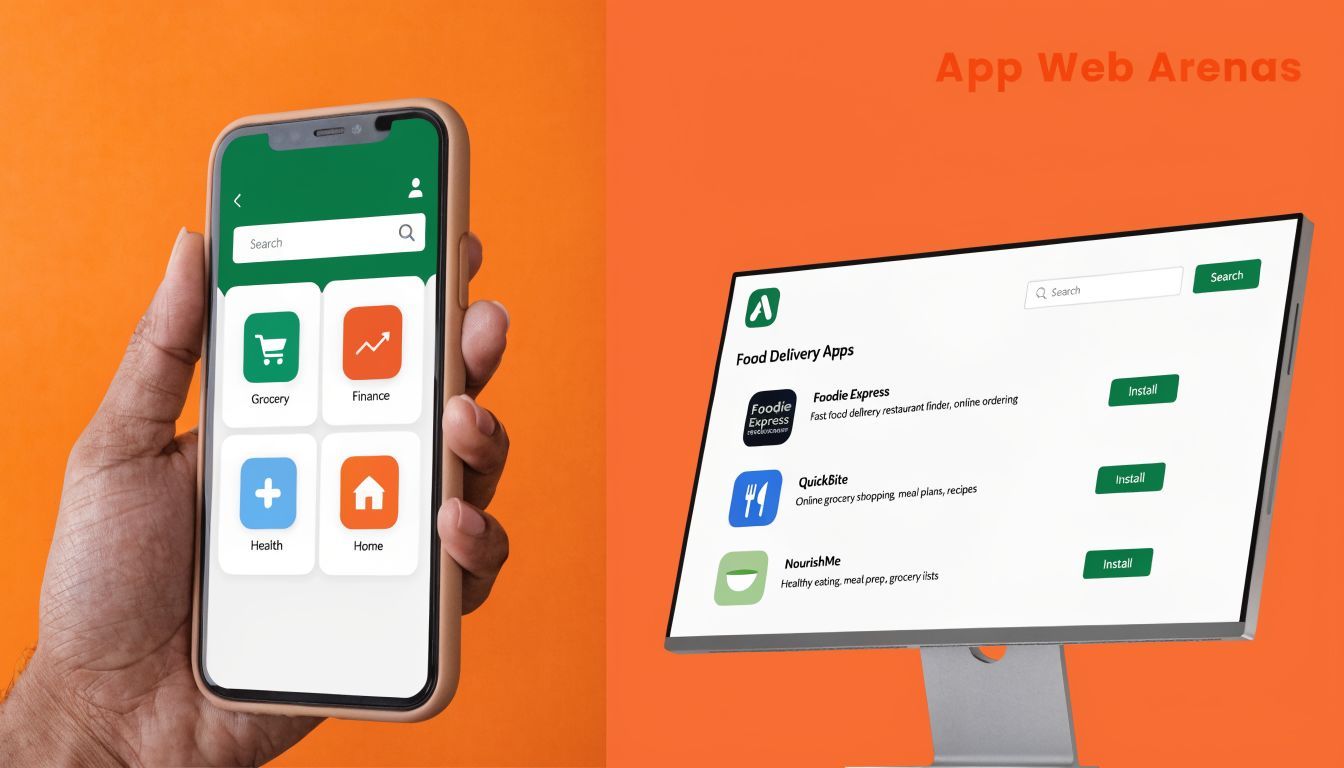
ASO lives inside closed ecosystems. Apple App Store and Google Play control the search surface, the listing layout, the ranking signals, and the conversion environment. You can influence your position and your install rate, but you’re working inside a defined storefront.
That’s why I describe ASO as digital merchandising. A person walks into a store already expecting to pick something off the shelf. Your job is to appear for the right query and make the product feel like the obvious choice.
The web is a library and a highway#
SEO operates on the open web. Search engines index pages, evaluate relevance, and connect searchers to many possible answer formats. A user might want a how-to guide, a comparison, a review, a product page, a video, or a direct brand result.
That makes SEO broader and messier. It also makes it powerful earlier in the journey. A person searching the web often hasn’t decided to install anything yet. They may just know the problem.
According to MobileAction’s comparison of ASO and SEO, app store searches account for 65% of app downloads globally as of 2024 data, while SEO contributes around 40 to 50% of website traffic in major markets like the US and Europe. That gap tells you something important. Search inside app stores isn’t a side channel for apps. It’s core demand capture.
Intent is the real dividing line#
The easiest way to understand aso vs seo is to look at intent.
- ASO intent is usually tighter. People search “budget planner,” “habit tracker,” or “video editor” because they’re willing to install if the listing looks right.
- SEO intent is wider. People search “how to manage monthly budget,” “best habit apps for ADHD,” or “video editor for short tutorials” because they’re still evaluating language, needs, and options.
SEO often introduces the category. ASO often closes the decision.
If your team mixes these intents together, execution gets blurry. You end up writing store copy like a blog post, or writing blog posts that sound like install ads. Neither performs especially well.
ASO vs SEO A Head to Head Comparison#
The fastest way to stop treating these channels as substitutes is to compare them on operating characteristics. Not theory. Actual day-to-day behavior.
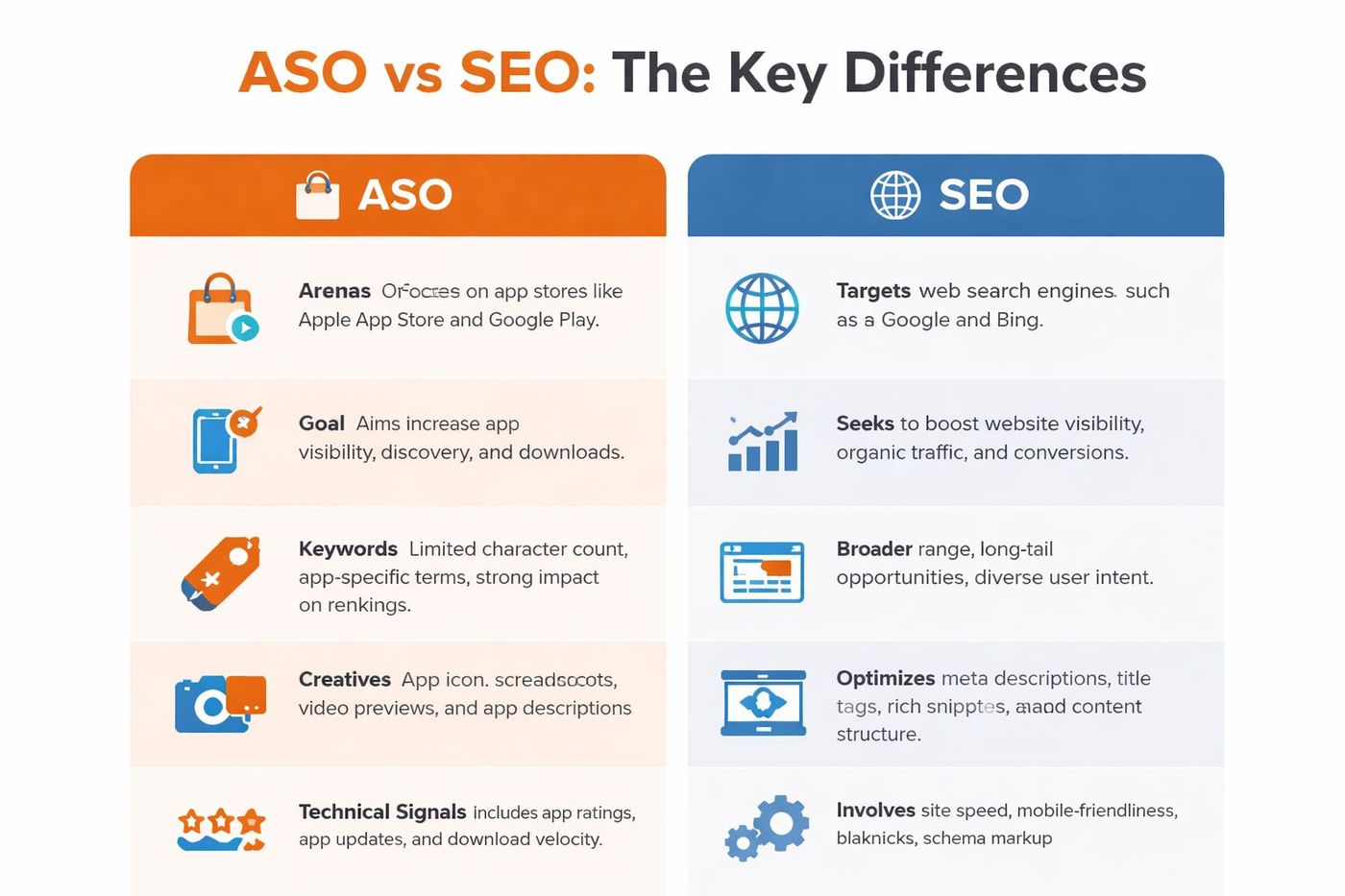
A quick comparison table#
| Area | ASO | SEO |
|---|---|---|
| Primary arena | Apple App Store and Google Play | Google, Bing, and the broader web |
| Primary goal | Increase visibility and app installs | Increase discoverability, traffic, and downstream conversions |
| User mindset | Closer to install intent | Often earlier research or problem discovery |
| Main assets | Title, subtitle or short description, icon, screenshots, preview video, ratings | Titles, meta descriptions, landing pages, articles, site architecture, internal links |
| Keyword style | Tighter, more app-category focused | Broader, including informational and comparison queries |
| Creative leverage | Very high. Visuals heavily shape conversion | Important, but text and page usefulness lead |
| Technical leverage | Product quality signals, ratings, review health, listing setup | Crawlability, speed, content structure, internal linking, authority |
| Feedback speed | Faster for conversion tests inside stores | Slower, especially for ranking movement |
| Typical team question | “How do we get more installs from store impressions?” | “How do we get the right people to discover and trust us?” |
This is why the same growth person often struggles when they switch between the two. ASO rewards crisp positioning, visual proof, and conversion discipline. SEO rewards depth, structure, topical coverage, and patience.
Why the speed gap changes team behavior#
One of the most practical differences is feedback velocity. According to The App Launchpad’s ASO vs SEO analysis, ASO changes show results within days rather than weeks or months, because app store algorithms respond to install conversion rate, ratings velocity, and user engagement signals more immediately.
That changes how a smart team operates.
- With ASO, teams can test screenshot order, icon direction, or subtitle phrasing and read the effect quickly.
- With SEO, teams usually wait longer because search engines need time to crawl, index, reassess relevance, and settle ranking volatility.
- With limited resources, that means ASO is often the faster lever for improving store conversion, while SEO is the compounding lever for category discovery and trust.
If you need faster signal, stores are usually the shorter loop. If you need broader category reach, the web is usually the bigger surface area.
This doesn’t mean ASO is “better.” It means each channel solves a different problem. Founders get into trouble when they apply SEO expectations to ASO or ASO expectations to SEO. A screenshot refresh won’t behave like a content cluster. A new blog article won’t behave like a subtitle update.
A Tactical Deep Dive Keywords Creatives and Technical Signals#
Execution is where the distinction often becomes clear. At a high level, aso vs seo sounds like “keywords plus optimization.” In practice, the job branches into three different workstreams: how you choose terms, how you present the product, and which non-copy signals influence performance.
Keywords work differently because intent is different#
Store searches are usually compressed. Users type category terms, short use cases, or brand names. Web searches stretch out into problems, comparisons, and workflows.
A finance app is a useful example. In ASO, the team may focus on terms like “budget planner” or “expense tracker.” In SEO, the same product can support pages built around phrases such as “how to track freelance expenses” or “best way to separate personal and business spending.”
That distinction affects page design too. Your app listing doesn’t need a full educational essay. Your website often does. One is persuading. The other is educating, framing, and qualifying.
If you’re building the keyword side properly, a strong app store keyword research workflow helps separate install-ready phrases from broader problem-led queries before the copy and visual work begins.
Creatives are optional in SEO and central in ASO#
This is the place where many web-first marketers underestimate ASO.
According to ValueHits on ASO vs SEO, visual assets function as the primary conversion mechanism in app stores. The icon acts as a first-impression anchor, screenshots communicate feature clarity, and preview videos drive install intent. The same source notes that Store CVR is directly influenced by visual composition quality and feature clarity.
That’s a very different operating model from SEO. On the web, a good image can improve engagement and support comprehension, but it usually isn’t the core ranking and conversion engine in the same direct way.
For app teams, this means screenshots need to do more than “look polished.” They need to answer the user’s decision question quickly. What does the app do? Why is it different? Which pain point does the first screen resolve? Is the order of proof obvious?
A practical store sequence often works like this:
- Problem claim first
Lead with the job the user is trying to get done. - Feature proof second
Show the exact UI moment that proves the promise. - Outcome framing third
Reinforce what gets easier, faster, or clearer after install.
Technical work still matters in both channels#
Technical SEO usually means page quality, crawlability, structure, speed, and how well your site helps search engines understand content.
Technical ASO is different. It lives closer to product quality and listing health. Ratings, review patterns, update quality, and app experience all influence whether the store keeps surfacing you and whether users convert once they land.
A weak website can bury strong content. A weak product experience can bury strong ASO creatives.
That’s why “metadata optimization” alone rarely fixes growth. Stores and search engines both reward relevance, but they also react to the experience users get after the click.
The Synergy Strategy Making SEO Insights Fuel ASO Creatives#
The missed opportunity isn’t choosing one channel over the other. It’s failing to let one channel teach the other what users care about.
A lot of teams still run SEO and ASO as separate research tracks. The SEO side gathers language from search queries, landing page tests, and content performance. The ASO side works from store keyword tools, competitor screenshots, and listing iterations. According to Flying V Group’s write-up on SEO vs ASO, existing content rarely explains how to systematically reuse SEO-driven user intent and keyword insights to inform ASO creative direction and screenshot sequencing.
That gap matters because the web often gives you richer language than the store.
Turn search intent into screenshot narrative#
Suppose your app helps freelancers manage money.
Your SEO research might uncover themes like:
- “how to track freelance expenses”
- “separate tax money automatically”
- “simple bookkeeping for self employed”
- “budget app for irregular income”
Those aren’t just blog topics. They’re clues about what users care about most, what language they trust, and which promise should show up first.
If the winning web theme is “track freelance expenses without spreadsheets,” your first screenshot probably shouldn’t lead with a generic phrase like “Smart Finance Dashboard.” It should mirror the actual job the user wants done.
A tighter sequence could look like this:
| SEO insight | ASO translation |
|---|---|
| Users search for help tracking expenses | First screenshot headline focuses on expense tracking clarity |
| Users worry about tax separation | Second screenshot shows the app flow tied to tax organization |
| Users want simplicity | Visual style reduces clutter and highlights one action per frame |
| Users compare alternatives | Copy emphasizes the specific workflow your app makes easier |
Teams secure an advantage. SEO gives you language and problem framing. ASO turns that into immediate visual proof.
A practical workflow for small teams#
A simple operating loop works well.
First, gather your best-performing SEO themes from search console data, landing pages, and article clusters. Don’t start with volume obsession. Start with intent patterns and recurring phrasing.
Second, group those themes by user job. For example, “save time on bookkeeping” and “track client expenses” may belong to different screenshot narratives.
Third, build your screenshot order around those jobs, not around feature parity checklists. Most weak listings read like release notes. Strong listings tell a short, convincing story.
After you’ve mapped intent to visual direction, this walkthrough is a useful companion for shaping mobile app mockups that actually support store conversion.
A practical explainer helps here:
The key discipline is consistency, not duplication. Your SEO page doesn’t need to copy your store screenshots word for word. It should, however, prepare the same promise that the store page then confirms.
Measuring Success and Allocating Growth Resources#
The reporting mistake is simple. Teams measure SEO in one dashboard, ASO in another, and creative learning never crosses the wall.
That’s expensive. It forces you to rediscover the same user message twice.
Build one experiment system not two reporting silos#
A better approach is to treat both channels as parts of one acquisition system. The audience segment is the same. The wording changes slightly by surface, but the underlying intent should travel across channels.
According to Wix’s discussion of ASO vs SEO, emerging data in 2025–2026 shows that teams using data-driven creative testing in stores can lift conversion rates by 20 to 30%, yet few resources explain how to align those tests with the same audience segments used in SEO and paid channels.
That alignment is where the practical gains happen.
- If an SEO landing page wins with a pain-point headline, test that promise in your first or second screenshot.
- If a store creative set wins because one feature frame gets attention, promote that feature more aggressively on comparison pages and product pages.
- If a user segment responds to simpler language on the web, don’t switch to abstract brand copy in the store.
Measure the message, not just the channel. Winning language is portable.
A lightweight scorecard can help:
| Shared input | SEO expression | ASO expression |
|---|---|---|
| Core pain point | Landing page headline | Screenshot headline |
| Primary proof | Product section or demo page | UI-led screenshot |
| Objection | FAQ or comparison content | Subtitle or later screenshot caption |
| Outcome | CTA section | Final conversion frame |
When to lean harder into ASO or SEO#
If you’re a mobile-first business and most value happens after install, ASO usually deserves earlier operational focus. The listing is the conversion gate. A mediocre store page wastes demand from every other channel.
If your category needs education, comparison, or trust-building before someone commits, SEO usually deserves more attention earlier. The website can explain use cases, support reviews and comparisons, and create intent that eventually travels into the store.
For many startups, the right answer is staged.
- Start with ASO when the product is clear, category demand is obvious, and your store page is weak.
- Start with SEO when users need more education, your category is crowded, or your website currently does almost nothing to shape intent.
- Run both together when you already have demand coming from multiple surfaces and your biggest issue is message inconsistency.
Frequently Asked Questions about ASO and SEO#
A practical way to think about this is to follow one app through the funnel.
Take a habit tracking app. The team publishes SEO content around problems like building routines, staying consistent, and choosing between tracking methods. Those pages attract users who are still learning. From there, visitors hit a product page and click into the store. Inside the listing, ASO takes over with a sharper promise, a stronger icon, and screenshots that show exactly how the app supports the habit-building workflow. Same audience. Different decision stage.
That example is why most founders eventually stop asking “aso vs seo, which one matters?” and start asking “where is the user in the decision process?”
FAQ ASO vs SEO#
| Question | Answer |
|---|---|
| Should a new app focus on ASO or SEO first? | If your main bottleneck is poor store conversion or weak in-store discoverability, start with ASO. If users need education and category framing before they’re ready to install, start with SEO. |
| Can ASO and SEO use the same keywords? | Sometimes, but not automatically. The core theme can overlap, while the exact phrasing often changes because web intent is broader and app-store intent is more install-driven. |
| Why do screenshots matter so much in ASO? | Because the store listing is a compressed decision environment. Users want fast proof that the app solves their problem. Visuals carry a large share of that job. |
| Why does SEO usually take longer? | Web search depends on indexing, ranking evaluation, and broader authority signals. That creates a longer feedback loop than store listing changes. |
| What should a small team test first? | Test your message before testing design flourishes. On the web, that might be headline framing. In the store, that’s often screenshot order, headline wording, and the first visual proof point. |
| What’s the biggest coordination mistake? | Treating SEO content themes and ASO creative themes as unrelated projects. When that happens, users hear one promise on the web and see another in the store. |
The useful takeaway is simple. SEO helps you learn what people mean. ASO helps you prove you’re the app they should install.
If your team needs to turn real app UI into store-ready screenshots faster, AppGrowKit is built for that workflow. It analyzes authentic product screens, helps shape visuals around ASO intent, and gives mobile teams a faster path from keyword insight to App Store and Google Play creative.
Stop reading. Start ranking.
AppGrowKit takes everything in this article and runs it for you: keyword research, live ranks, conversion-focused screenshots, and market intel. Free to start.